Knife Skills for Home Cooks: Cut Faster Without Feeling Unsafe
Knife skills aren’t about looking fancy—they’re about removing friction. When your cuts feel shaky, prep takes forever, sizes come out uneven, and cooking gets harder than it needs to be. The good news: you don’t need twenty techniques. You need a stable grip, a safe guiding hand, and a few cut patterns you can repeat without thinking.
This article is part of the Master Cooking Techniques hub, where the core skills ladder together into faster, more consistent results.

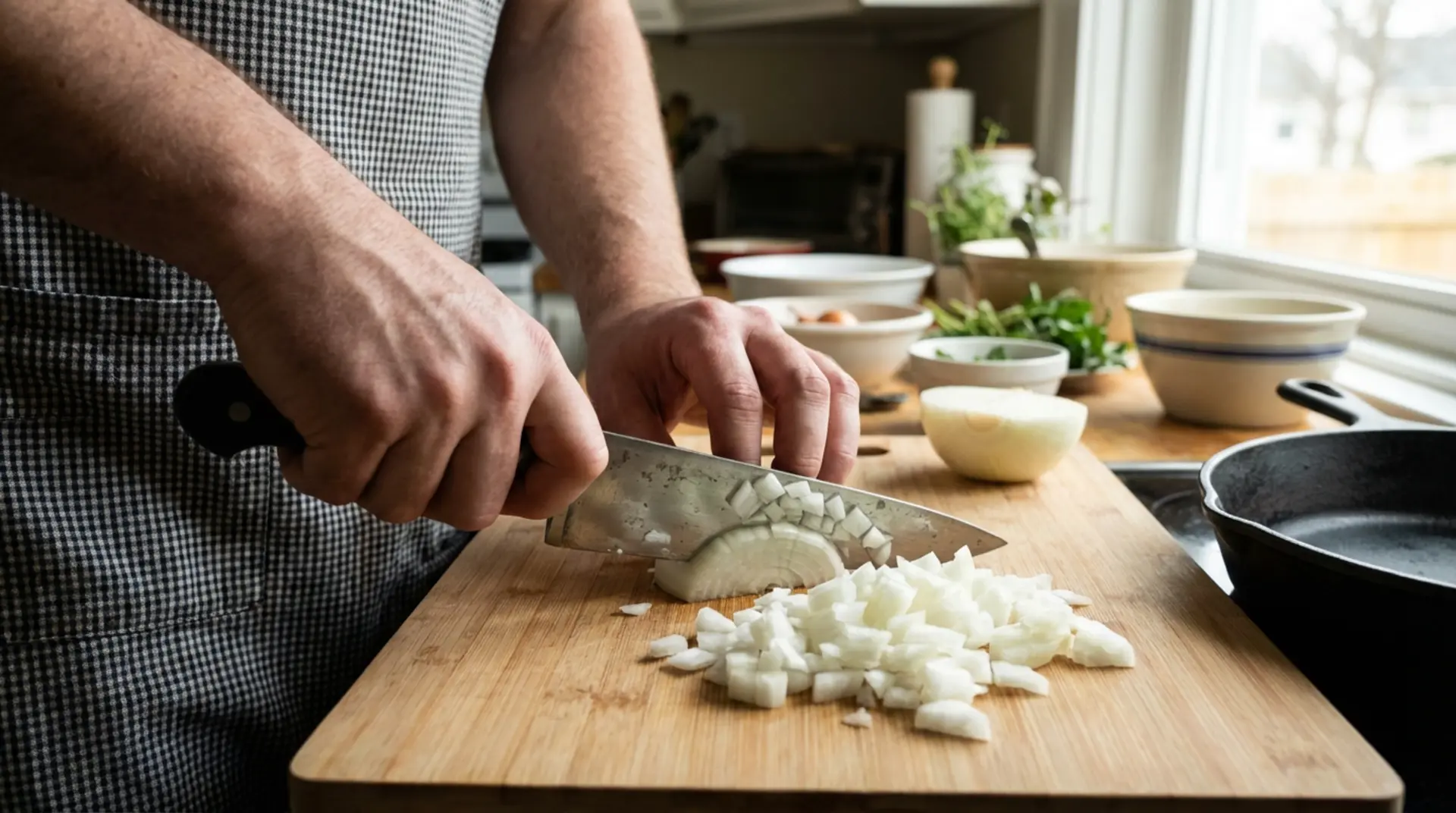
Pinch grip knife technique (the only grip you need)
If your knife feels “wobbly,” it’s usually the grip. The pinch grip fixes that immediately because it puts control where the knife actually pivots: at the blade. To do it, pinch the blade itself (not the handle) with your thumb and index finger just in front of the bolster, then wrap your remaining fingers around the handle. It will feel weird for a minute if you’re used to holding the knife like a hammer, but it’s the fastest path to control.
Why it matters: control reduces fear, and reduced fear makes speed possible. When you grip the handle only, the knife becomes a lever that can twist as it hits tougher spots (like carrot or sweet potato). With a pinch grip, the blade stays stable and your cuts become straighter. Your wrist also stays more neutral, which reduces fatigue over long prep sessions. If you want prep to feel less like a chore—and more like a flow state—this is the first upgrade.
Claw grip finger safety (protect your fingers automatically)
Most knife anxiety comes from the guiding hand, not the knife hand. The claw grip is the simplest safety system because it physically removes your fingertips from the blade path. Curl your fingertips under, press the food with your knuckles, and keep the knife blade riding against those knuckles as a guide. The knife never needs to “search” for where to go—you’re giving it a safe wall to track.
Two details make the claw work: (1) keep the thumb tucked behind the fingers so it isn’t sticking out as a target, and (2) move your guiding hand back in small increments after each cut instead of lifting and repositioning dramatically. That tiny “ratchet” motion is how pros cut fast without feeling reckless. If the food is round and wants to roll (like onion halves or cucumbers), stabilize it first by creating a flat side—flat side down is a safety rule, not an aesthetic choice.
Slicing vs chopping vs dicing (which cut to use and when)
Most home cooks overthink “the right cut” when the real question is: what texture and cook time do you want? Slices cook faster and soften evenly. Chops give rustic variation and more surface area for browning. Dice creates uniformity, which is ideal when you want everything to cook at the same rate (soups, sautés, stir-fries, sheet-pan mixes). If you match the cut to the job, your cooking gets easier immediately.
Here’s a practical way to choose: If the ingredient needs to melt into the background (onion for sauce base), use a small dice so it softens fast. If it needs to keep structure (potatoes on a sheet pan), use larger, consistent chunks so the outside browns before the inside collapses. If it’s a quick-cook vegetable (zucchini, mushrooms), bigger pieces can help prevent overcooking and sogginess. This is why knife skills connect directly to roasting success—uniformity and smart sizing make Roasting Vegetables more predictable.
Uniform cuts for even cooking (why size changes results)
Uniform cuts aren’t about perfection—they’re about synchronization. When pieces are different sizes, they finish at different times. Small pieces overcook and dry out while larger pieces stay crunchy or raw in the center. That creates the illusion that your heat is wrong, when the real issue is geometry. The knife is a cooking tool because it sets the timeline before heat ever touches the food.
A simple rule: match thickness, not shape. Your carrot sticks don’t need to be identical rectangles, but they should be similar in thickness so heat reaches the center at the same time. For onions and herbs, smaller cuts release more aroma faster; for potatoes and roots, consistent chunks create consistent tenderness. When you’re building sauces or gravies, uniform aromatic cuts also reduce random scorching—tiny garlic bits burn while bigger onion pieces are still sweating. If you’re doing technique-driven thickening (like a roux-based sauce), consistent prep reduces rushed stirring and helps you work cleanly when you move into Making a Roux.
How to keep knives sharp (simple maintenance habits)
A sharp knife is safer than a dull knife because it requires less force. Dull knives slip; sharp knives bite. You don’t need a complicated sharpening setup to get most of the benefit—you need two habits: realigning the edge regularly and sharpening occasionally. Honing (with a honing rod) doesn’t remove much metal; it straightens the edge so the knife cuts cleanly again. Sharpening actually rebuilds the edge.
For most home cooks, the simplest system is: hone lightly before big prep sessions, and sharpen when the knife starts crushing tomatoes or sliding on onion skin. If you don’t want to learn stones, a basic pull-through sharpener or periodic professional sharpening can still be a massive upgrade over “never sharpen.” Also: protect the edge. Don’t scrape the blade sideways on the board (use the spine), avoid glass/stone cutting boards, and store knives so the edge isn’t banging around in a drawer. Better sharpness makes every other technique feel easier because prep stops draining your energy before you even start cooking.
Frequently Asked Questions
What is the safest way to hold a knife for beginners?
Use a pinch grip on the blade for control, then use the claw grip with your guiding hand so fingertips stay tucked. Keep a flat side of the ingredient down so it can’t roll. Most accidents happen when food shifts or when the knife slips due to a dull edge and too much force.
Why do chefs use the pinch grip instead of holding the handle only?
Pinching the blade gives direct control over the knife’s pivot point, so the edge tracks straighter and feels more stable. Handle-only grips create more twist and wobble, especially in dense foods. More control means less force, less slipping, and faster, calmer prep.
How sharp does my knife need to be for normal home cooking?
Sharp enough to cut a tomato skin without crushing and to slice an onion without sliding off. If you’re pushing hard, the knife is too dull. You don’t need “razor sharp,” just consistently sharp. Honing helps day-to-day; sharpening restores the edge when performance drops.
Conclusion
Knife skills pay off immediately because they remove prep friction: you feel safer, you move faster, and your cooking becomes more even because your cuts are consistent. Start with the pinch grip and the claw—those two alone solve most beginner problems. Once prep stops draining you, every other technique becomes easier to execute on purpose.
Next Step: Learn Making a Roux for lump-free thickening
About