Perfect Hard-Boiled Eggs: No Gray Ring, No Sticking Shells
Hard-boiled eggs should be simple, but they’re a top-tier kitchen betrayal: shells that shred, green-gray rings, rubbery whites, and yolks that never match what you wanted. The fix isn’t luck—it’s a repeatable method that controls heat and timing, then stops cooking fast so the texture locks in.
This technique is part of the Master Cooking Techniques hub, where the core “master moves” stack into predictable results.

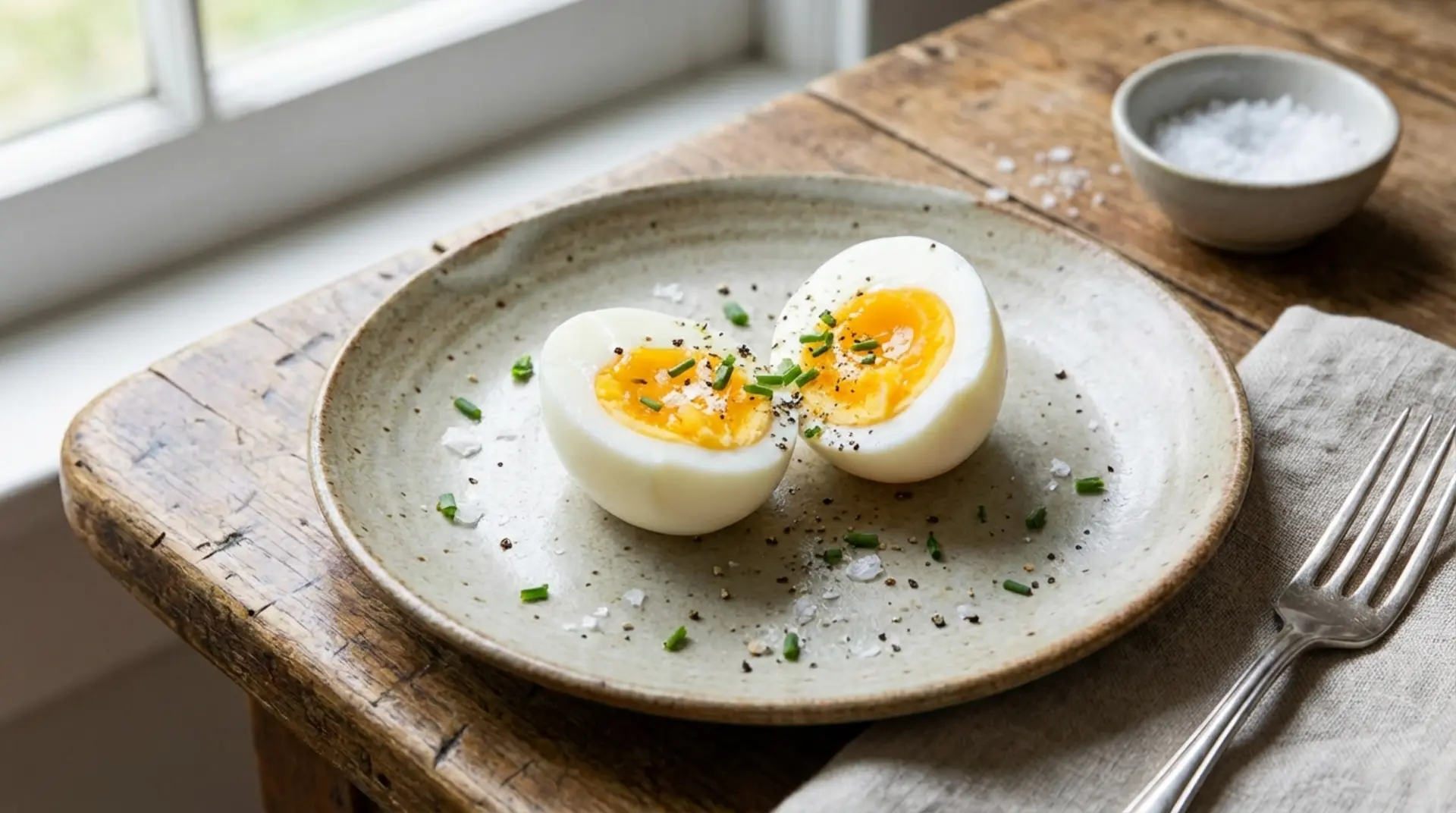
Steam vs boil hard-boiled eggs (best method for easy peel)
If your goal is clean peeling and repeatable doneness, steaming is the most forgiving method for most home kitchens. It heats the egg with saturated steam, which tends to cook more evenly and gently than a rolling boil that jostles eggs around. It also reduces cracking because the eggs sit above the water instead of bouncing against the pot. Boiling can work perfectly—but it’s more sensitive to “small chaos” variables like water temperature swings, pot size, and how aggressive the boil is.
Here’s the practical decision rule: choose steaming when you care most about easy peel and consistency; choose boiling when you’re already boiling pasta water or cooking a larger batch in a big pot and you can control the simmer. For steaming, add about 1 inch of water to a pot, bring it to a steady simmer, place eggs in a steamer basket, cover, and start timing once steam is consistent. For boiling, place eggs in water, bring to a boil, then reduce to a gentle simmer (or use a “boil then rest” approach). Either way, your results depend on heat control—if your stove runs hot/cold, it’s worth understanding the “zones” idea from Sautéing vs Searing because it’s the same skill: choosing the right intensity and movement for the job.
Hard-boiled egg timing chart (jammy to fully set yolk)
Timing is the whole game because eggs go from “perfect” to “chalky” fast. Use this as a practical chart for large eggs (add ~1 minute for extra-large; subtract ~30–60 seconds for medium). For steaming at a steady simmer: 9 minutes = jammy (set whites, creamy yolk); 10 minutes = medium set (soft-center yolk); 11 minutes = mostly firm (slightly creamy center); 12 minutes = fully hard-boiled (firm yolk). If you’re boiling, the times can be similar, but boiling often runs a touch harsher depending on how aggressive the simmer is.
Two details make these times actually reliable: (1) start timing when the condition is stable (steam is flowing or the simmer is steady), and (2) avoid “mystery heat spikes.” If you crank heat to regain a boil, you’re effectively changing the cooking curve. If you want jammy eggs consistently, don’t multitask the first few times—dial in your stove. Once you have your personal “stove profile,” it becomes automatic. If you regularly get underdone whites, your issue is usually that the heat wasn’t stable when you started the timer. If you regularly get dry yolks, your issue is usually carryover + slow cooling (fixed in the next section).
Ice bath for hard-boiled eggs (what it actually does)
The ice bath isn’t a tradition—it’s physics. Eggs keep cooking after you pull them off heat because the outer layers are hotter than the center. That carryover is what creates the green-gray ring (sulfur compounds reacting near an overcooked yolk edge) and what pushes “perfect” into “dry.” Rapid cooling stops carryover fast and makes the texture match your timing chart.
For best results, move eggs straight from heat into a bowl of ice water (or very cold running water if you’re out of ice) for 8–10 minutes. Don’t do a “quick dip”—that only cools the shell. You want the whole egg temperature to drop enough that cooking truly stops. Bonus: rapid cooling also helps with peeling because it can encourage the egg to contract slightly away from the shell as it cools. If you’re cooking a bigger batch, use more ice than you think you need—warm water becomes lukewarm fast, and then carryover quietly keeps happening. This is the same logic as resting meat (carryover cooking) but in reverse: here, you’re aggressively stopping the curve.
Easy-peel hard-boiled eggs (egg age, steam, and cracking technique)
Peel pain usually comes from one of three things: very fresh eggs, inconsistent heating, or peeling too “dry.” Fresh eggs have a lower pH and the membrane tends to cling more tightly to the white, which increases tearing. Older eggs (even 7–10 days old) often peel easier. Steaming also helps because the initial heat is more consistent, which sets the outer white cleanly instead of letting it fuse to the membrane in patches.
The fastest practical peeling method: crack the egg all over (not just one end), then start at the wider end where there’s usually an air pocket. Peel under a thin stream of running water or in the ice bath water—water gets between the membrane and the white and helps it release. If the shell is shredding, don’t “fight harder”; switch to peeling in water and widen the crack network. One more tip: if your eggs consistently stick, try making a tiny crack after cooking and before the ice bath so cooling water can slip into the shell/membrane area. It’s not magic, but it can make a noticeable difference on stubborn batches.
Hard-boiled egg storage and safety (simple rules)
Hard-boiled eggs are a meal-prep superpower, but only if you store them correctly. Cool them fully (ice bath), then refrigerate within 2 hours (1 hour if your kitchen is very warm). Keep them in the fridge in a covered container. Unpeeled eggs generally keep better and smell less because the shell protects them. Peeled eggs dry out faster, so store peeled eggs with a damp paper towel in the container or submerged in clean water (change the water daily).
Practical shelf-life: unpeeled hard-boiled eggs are best within about 1 week in the fridge; peeled eggs are best within 3–5 days for texture. If an egg smells strongly sulfurous when you open the container, that can be normal “egg smell”—but if it smells rotten or the white has a weird slimy texture, toss it. Also: don’t leave hard-boiled eggs out on the counter “for later.” Eggs are a high-risk food when abused with time/temperature. Treat them like cooked chicken: chill promptly, store cold, eat on a reasonable timeline.
Frequently Asked Questions
How long should I steam eggs for hard-boiled eggs that peel easily?
For large eggs at a steady simmer, start with 12 minutes for fully hard-boiled, 10–11 minutes for a slightly softer center, and 9 minutes for jammy. Move eggs immediately into an ice bath for 8–10 minutes to stop carryover. Steaming + rapid cooling is the most consistent combo for clean peeling.
Why do my hard-boiled eggs get a gray-green ring around the yolk?
The ring is a classic sign of overcooking and slow cooling. The egg keeps cooking after you remove it from heat, and the yolk edge reacts with sulfur compounds, creating the gray-green color. Use a slightly shorter cook time and a real ice bath (8–10 minutes) to stop carryover quickly.
Do fresh eggs or older eggs peel better for hard-boiled eggs?
Slightly older eggs usually peel better. Very fresh eggs tend to cling because the membrane bonds more tightly to the white. If you only have fresh eggs, steaming helps, and peeling under water makes a big difference. Rapid cooling also improves peel performance by reducing sticking patches.
Conclusion
Perfect hard-boiled eggs come down to three controllable levers: consistent heat (steaming is easiest), a timing chart you can repeat, and rapid cooling so carryover doesn’t wreck the texture. Once you lock those in, peeling becomes predictable instead of personal. Make a few batches, note your stove’s behavior, and you’ll have “perfect eggs” on autopilot.
Next Step: Learn Deglazing to turn fond into a fast pan sauce
Latest posts
About