Béchamel Roux Ratio for Smooth White Sauce
The béchamel roux ratio is what separates a smooth white sauce from one that turns lumpy, pasty, thin, or weirdly floury. Once you understand how butter, flour, and milk work together, béchamel becomes one of the easiest foundation sauces to repeat.
Béchamel is a classic mother sauce, but it is also incredibly practical for mac and cheese, lasagna, casseroles, gratins, cream sauces, and vegetable bakes. For the full sauce-building framework behind stocks, roux, emulsions, pan sauces, and flavor balance, start with the main sauces and foundations guide.

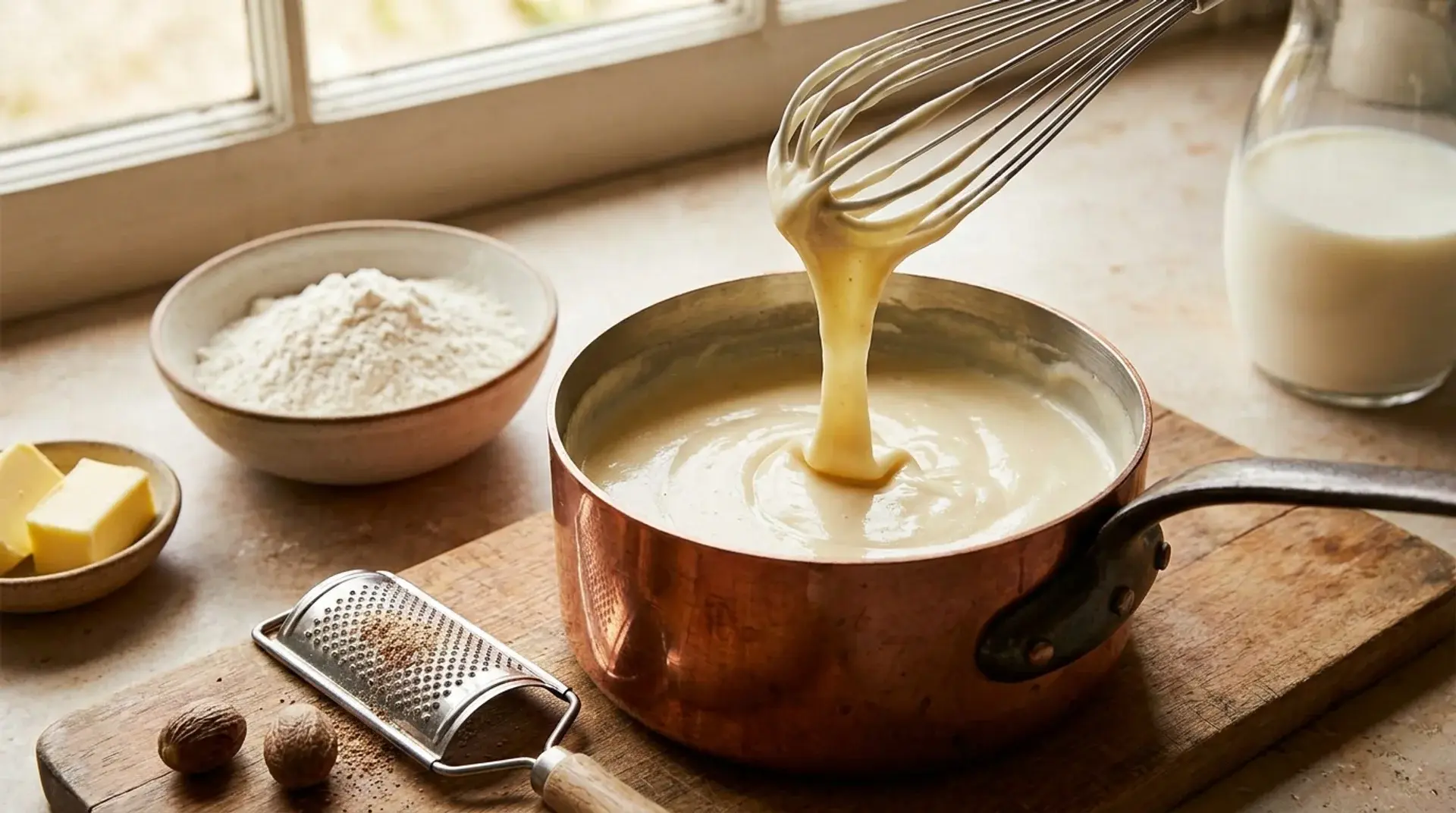
What is the basic béchamel ratio?
The basic béchamel ratio starts with equal parts butter and flour for the roux, then enough milk to create the thickness you want. A common medium sauce uses about 2 tablespoons butter, 2 tablespoons flour, and 1 cup milk. This gives you a smooth white sauce that is thick enough to coat a spoon but still loose enough to stir into pasta, vegetables, or baked dishes.
For a thinner béchamel, use the same amount of milk with less roux, or add more milk after the sauce thickens. For a thicker béchamel, use more butter and flour for the same amount of milk. The roux is the thickening structure, so changing the roux changes the body of the sauce. The milk controls how loose or concentrated that structure feels.
A simple way to remember it is this: equal butter and flour, then adjust the milk based on the final use. A pourable white sauce for vegetables or crepes should be thinner. A medium sauce for mac and cheese or casseroles should coat the spoon. A thick béchamel for croquettes, soufflé-style bases, or firm fillings needs more roux and less looseness.
The ratio is only the starting point. Heat, whisking, milk temperature, cooking time, and seasoning all matter too. If the sauce tastes pasty, the roux may need more cooking. If it tastes bland, it likely needs more salt. If it feels too thick, more milk fixes it quickly. If it is too thin, gentle simmering or a little more thickening can bring it back.
How roux thickens milk into sauce
Roux thickens milk because flour starches absorb liquid and swell as they heat. Butter coats the flour, helps it cook evenly, and keeps the starch from clumping immediately when liquid is added. When milk is whisked into the roux and brought to a gentle simmer, the starches hydrate and create the smooth body that makes béchamel feel like sauce instead of warm milk.
The first step is cooking the butter and flour together long enough to remove the raw flour taste. For béchamel, the roux usually stays pale. You are not trying to brown it deeply like you would for darker sauces. You just want it to smell slightly nutty or cooked instead of dusty and raw. This usually takes a minute or two over moderate heat, depending on the pan and burner.
After the roux is cooked, the milk needs to be added gradually while whisking. This part matters because a thick paste can only absorb so much liquid at once. If you dump in all the milk quickly and do not whisk well, the outside of the roux can hydrate unevenly and form lumps. Adding milk in stages creates a smoother transition from paste to thick liquid.
Béchamel is one of the clearest ways to understand roux-thickened sauces. Once the method makes sense, stock-based sauces become much easier too. The same roux logic appears in velouté sauce with stock and roux, where the liquid changes from milk to stock but the thickening principle stays familiar.
How to prevent lumps in béchamel
To prevent lumps in béchamel, add the milk slowly at first and whisk constantly. The riskiest moment is the first liquid addition because the roux is thick and the milk needs to be absorbed evenly. Start with a small splash of milk, whisk until the mixture becomes smooth, then add another splash. Once the sauce loosens, you can add the remaining milk more steadily.
Temperature also affects lumping. Some cooks prefer warm milk because it blends into roux more easily and brings the sauce up to temperature faster. Cold milk can still work, but it may need more gradual whisking. The key is not really whether the milk is hot or cold. The key is steady incorporation. Roux and liquid need time to combine before the sauce fully thickens.
Use the right whisking pattern
Whisk across the whole bottom of the pan, not just the center. Lumps often hide along the edges where flour paste sits untouched. A flat whisk can help in a saucepan, but any whisk works if you move deliberately. Scrape the corners, keep the sauce moving, and do not walk away while it thickens.
Fix small lumps before they set
If you see small lumps forming, lower the heat and whisk aggressively. Many lumps will smooth out before the sauce finishes thickening. If the sauce is still lumpy after cooking, strain it through a fine mesh sieve. That is not failure. It is a clean fix, and the final sauce can still be perfectly usable.
Thin, medium, and thick béchamel ratios
Thin, medium, and thick béchamel ratios depend on how much roux you use for each cup of milk. A thin béchamel usually uses about 1 tablespoon butter and 1 tablespoon flour per 1 cup milk. This creates a light, pourable sauce for vegetables, crepes, or delicate dishes where you want creaminess without heaviness.
A medium béchamel usually uses about 2 tablespoons butter and 2 tablespoons flour per 1 cup milk. This is the most flexible version for home cooking. It coats a spoon, holds its shape lightly, and works well for mac and cheese, casseroles, gratins, lasagna, and general white sauce. If you only memorize one ratio, make it this one.
A thick béchamel usually uses about 3 tablespoons butter and 3 tablespoons flour per 1 cup milk. This creates a dense sauce that can hold fillings together or act as a base for dishes that need more structure. It is less pourable and more spoonable. This can be useful, but it can also feel pasty if the roux is undercooked or the sauce is not seasoned well.
The final texture also changes as the sauce cools. Béchamel thickens more once it sits, especially if it is going into a baked dish. If you are making sauce ahead, leave it slightly looser than you think you need. When reheating, whisk in a small amount of milk to bring it back to the right consistency.
Common béchamel mistakes and quick fixes
The most common béchamel mistakes are lumps, raw flour flavor, scorching, blandness, and the wrong thickness. Lumps usually come from adding milk too quickly or not whisking enough. Raw flour flavor means the roux was not cooked long enough before the milk went in. Scorching happens when the heat is too high or the sauce sits on the bottom of the pan without movement.
If béchamel is lumpy, lower the heat and whisk hard. If the lumps remain, strain the sauce. If it tastes like raw flour, keep cooking it gently for a few minutes while stirring. If the sauce is scorched, do not scrape the burned bottom into the sauce. Pour the unburned sauce into a clean pan and continue from there. If the burnt flavor has spread through the whole sauce, it is usually better to remake it.
If the sauce is too thick, whisk in more milk a splash at a time until it loosens. If it is too thin, simmer it gently so water evaporates and the starch has more time to thicken. If it still will not thicken, the roux ratio may have been too low for the amount of milk. You can fix it with a small separate roux, a beurre manié, or another appropriate thickener, but add carefully so the sauce does not become gluey.
If béchamel tastes bland, it probably needs salt. This sauce is mild by nature, so seasoning matters. Add salt gradually, then consider white pepper, black pepper, nutmeg, cheese, mustard, herbs, garlic, or onion depending on the dish. For more context on where béchamel fits inside classic sauce technique, see the mother sauces overview.
Frequently Asked Questions
What is the best béchamel roux ratio?
The best béchamel roux ratio for a medium white sauce is usually 2 tablespoons butter, 2 tablespoons flour, and 1 cup milk. Use less roux for a thinner sauce and more roux for a thicker sauce. Equal parts butter and flour are the standard base.
Why is my béchamel sauce lumpy?
Béchamel usually turns lumpy when milk is added too quickly or the sauce is not whisked thoroughly. Add the milk gradually at first, whisk until smooth between additions, and scrape the edges of the pan. If lumps remain after cooking, strain the sauce through a fine mesh sieve.
How do you fix béchamel that is too thick?
To fix béchamel that is too thick, whisk in more milk a small splash at a time over low heat. Keep whisking until the sauce loosens and turns smooth again. Béchamel also thickens as it cools, so reheated sauce often needs extra milk to restore the texture.
Conclusion
Béchamel roux ratio is simple once you know the structure: equal parts butter and flour, then milk adjusted for the texture you want. Use less roux for a thin sauce, a medium ratio for most everyday cooking, and more roux when you need a thicker base.
The real skill is not just measuring. Cook the roux long enough to remove raw flour flavor, add milk gradually, whisk steadily, and season the sauce until it tastes complete. Once béchamel makes sense, roux-thickened sauces become much easier across the board.
Latest posts




About